A Complete Guide to Fastener Selection for Industrial and Everyday Applications
Screws are among the most fundamental yet critical components in industrial manufacturing, equipment installation, and everyday maintenance. Choosing the right screw head type for each application ensures optimal fastening performance, durability, and a clean finish. In this guide, we break down the structure of a screw and walk through ten common head types to help you make informed fastener decisions.
The Basic Anatomy of a Screw
A standard screw consists of three main parts:
The head is the top portion of the screw. It defines how the screw is installed and how the finished assembly looks.
The drive is the recess in the head, designed to receive a matching tool for tightening and loosening.
The thread is the helical ridge along the shank that determines gripping strength and compatibility with nuts or tapped holes.
Common Screw Head Types Explained
1. Pan Head
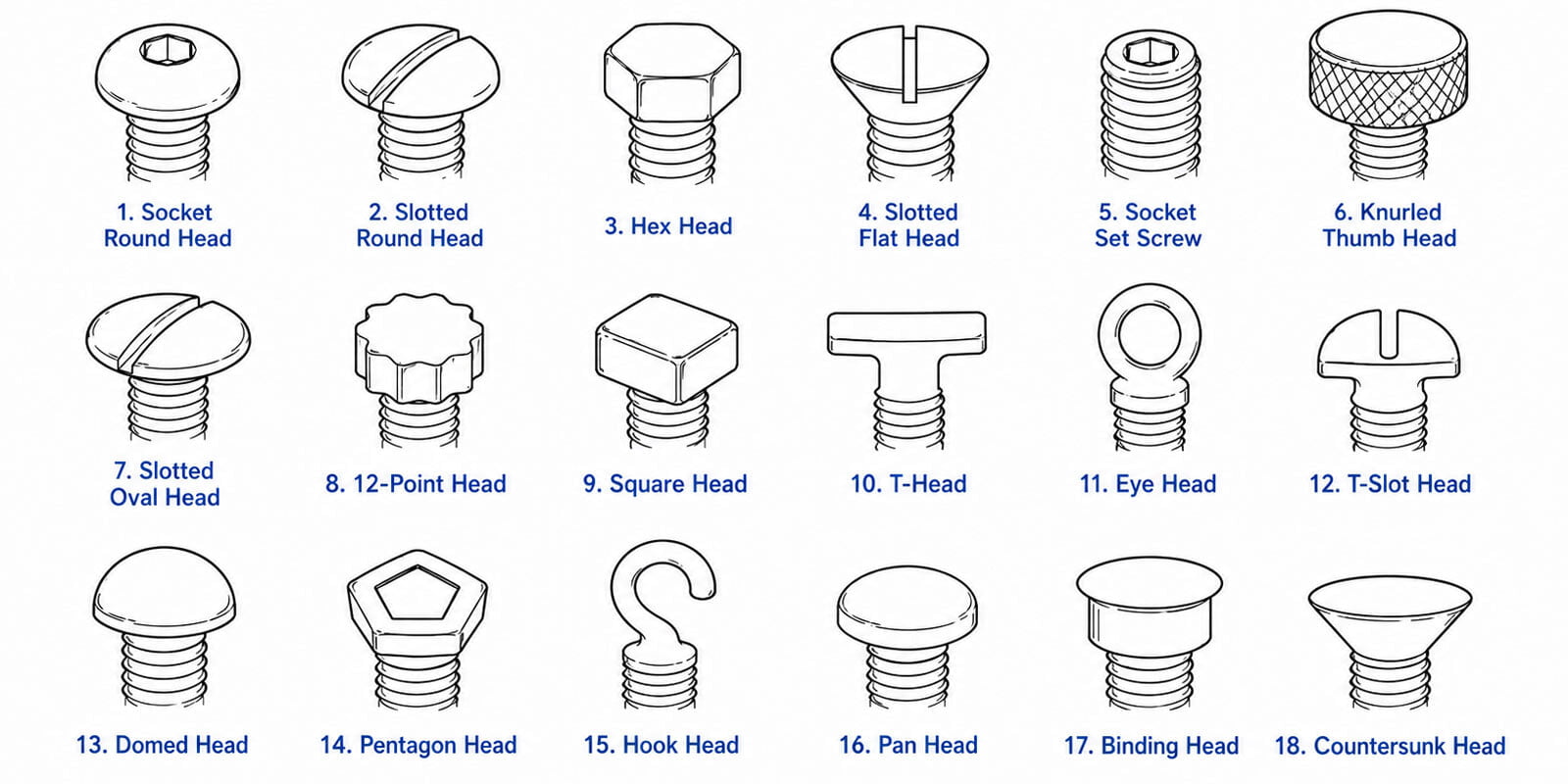
The pan head is one of the most widely used head styles, featuring a rounded, slightly domed top with a flat bearing surface underneath. Its large contact area distributes clamping force evenly, making it suitable for the majority of general-purpose fastening tasks.
2. Countersunk Head (Flat Head)
The countersunk head, often called a "K head," has a conical underside designed to sit flush with the surface once tightened. Because it leaves no protrusion, it is ideal for applications where a smooth, level finish matters, such as furniture assembly and precision equipment installation.
3. Oval Head (Semi-Countersunk)
The oval head combines a conical underside with a rounded top. When installed, the head sits slightly above the surface, offering partial flushness while adding strength to the head itself. It works well where solid fastening is needed but full countersinking is not desired.
4. Truss Head (Mushroom Head)
The truss head has a large diameter with a low, rounded profile resembling a mushroom cap. Its wide bearing surface prevents damage to thin or soft materials such as sheet metal and plastics, which might otherwise collapse under concentrated pressure.
5. Button Head / Extra-Large Flat Head (Ultra-Low Profile Head)
This head style is thin and low in height, making it perfect for tight spaces where clearance is limited. It is commonly found in home appliance housings and inside electronic devices where components must be secured without adding bulk.
6. Hex Head
The hex head features an external six-sided shape driven by a wrench or socket. It accepts high torque and delivers strong clamping force, making it the go-to choice for demanding applications in machinery construction and building projects.
7. Cylinder Head (Socket Head Cap Screw)
The socket head cap screw has a cylindrical head with an internal hex drive. Its thick head withstands high torque while presenting a clean appearance, which is why it is favored in mold making and precision mechanical assembly.
8. Square Head
The square head has an external four-sided profile that resists slipping during tightening and removal. It suits applications requiring frequent disassembly or a firm anti-slip grip, such as outdoor equipment and heavy machinery.
9. Pan Head with Integral Washer (Flanged Pan Head)
This design combines a standard pan head with an integrated flange that functions like a built-in washer. The enlarged bearing surface spreads clamping pressure over a wider area, protecting soft or delicate materials from damage.
10. Headless Set Screw (Grub Screw / Allen Set Screw)
The set screw has no head at all and is fully threaded along its length. Installed flush with or below the surface, it serves as an internal locking element, ideal for securing shafts to hubs, positioning molds, and other precision alignment tasks.
Key Factors for Selecting the Right Screw Head Type
Installation space: In confined areas, opt for low-profile options such as button heads or set screws.
Required torque: For high clamping forces, choose thick-headed styles like hex heads or socket head cap screws.
Appearance requirements: When a flush, smooth surface is essential, countersunk and oval heads are the best fit.
Material being fastened: For soft materials, select heads with large bearing surfaces, such as truss heads or pan heads with integral washers.
Choosing the correct screw head type goes beyond simple preference. It directly affects fastening strength, surface finish, and the longevity of the assembly. Whether you are sourcing standard pan head screws for general use or specialized set screws for precision positioning, GD Fastenal offers a comprehensive range of fastener solutions to meet every requirement.

