
How Self-Tapping Screws Work
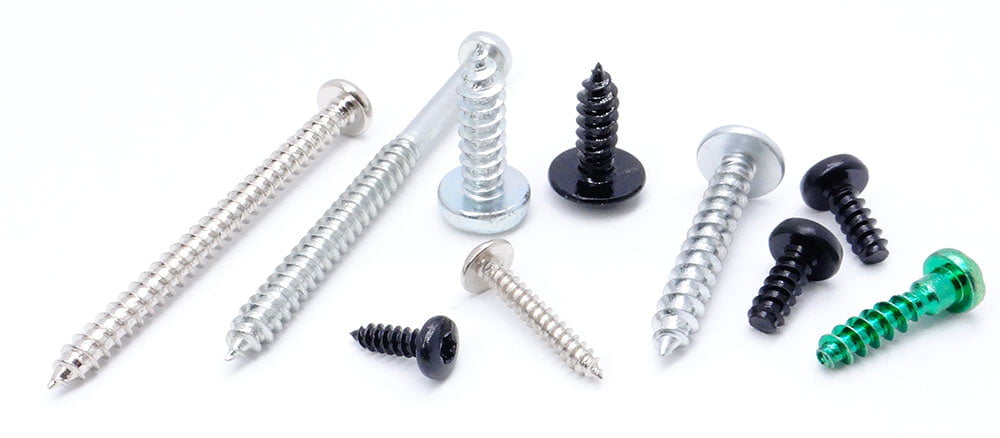
A self-tapping screw has sharp threads and a relatively large pitch. During installation, the threads cut into or displace the material to form matching internal threads.They can be installed directly with a screwdriver or power drill and usually do not require a separate nut. For metal applications, the screw should have suitable hardness to reduce the risk of slipping, stripping, or breaking.
Self-tapping screws simplify assembly and reduce processing time because drilling, tapping, and fastening can be completed in fewer steps. They are suitable for thin sheets, plastics, wood, and some composite materials.
Standard versions are generally better for permanent or limited-disassembly applications. Repeated removal may wear the formed threads and reduce fastening strength. For thermoplastic materials, PT-type self-tapping screws may be used when repeated assembly is required. Under suitable conditions, they can often be reused around five times, depending on the material, hole size, and installation torque.
Key Thread Measurements
- Major diameter: The largest diameter at the thread crest. It is mainly used to identify the screw size. For example, an ST3.5 screw has a nominal major diameter of approximately 3.5 mm.
- Minor diameter: The smallest diameter at the thread root. It is an important reference when designing a pilot hole.
- Pitch diameter: The effective diameter between the crest and root. It is important for checking thread accuracy and assembly quality.
Common Drive Types
- Phillips (PH): Developed in the United States in 1934. It is the most common drive type and is suitable for low to medium torque applications.
- Pozidriv (PZ): Developed in the United Kingdom in 1962. It provides better tool engagement and is often used in automated assembly.
- Torx: Developed in the United States in 1967. It offers stable torque transfer and is suitable for high-torque applications.
- Hex socket: Developed in Germany in 1936. It provides efficient torque transfer and is suitable for high-strength applications.
- Slotted: A simple and economical traditional drive type for low-torque applications.
- Plus-minus: A composite drive that works with both Phillips and slotted screwdrivers, making it useful for maintenance and emergency repairs.
Metric and Imperial Sizes
- Metric self-tapping screws are usually marked as ST plus a number, such as ST3.5 or ST4.2. Common sizes range from ST1.5 to ST9.5, with thread pitches from 0.5 mm to 2.1 mm.
- Imperial self-tapping screws are usually marked with a gauge number and thread count, such as #6-32 or #8-32. Common sizes range from #4 to #14, with approximately 24 to 40 threads per inch.
The basic conversion is 1 inch = 25.4 mm. Imperial gauge numbers do not directly indicate the screw diameter, so they should always be checked against the corresponding metric measurement.
How to Select the Right Screw
First, confirm the material type, thickness, strength, and required assembly torque. Next, measure the major diameter to identify the basic screw specification. Use the minor diameter as a reference when designing the pilot hole, and inspect the pitch diameter to ensure thread quality.
For plastic applications, the pilot hole size is especially important. An undersized hole may cause cracking or excessive installation torque, while an oversized hole may result in poor thread engagement and loose fastening.
Frequently Asked Questions
Q: Can self-tapping screws be used in metal?
A: Yes. They are commonly used in thin metal sheets. Material hardness, sheet thickness, screw design, and pilot hole size should all be considered.
Q: Can self-tapping screws be reused?
A: Standard versions are not recommended for frequent reuse because the internal threads may wear. PT-type screws are more suitable for repeated assembly in thermoplastics.
Self-tapping screws simplify assembly by forming threads directly in the base material. Choosing the correct diameter, drive type, thread design, and pilot hole size helps improve fastening strength and reduce installation problems.
For suitable self-tapping screw solutions, visit gdfastenal.com.

