
Select, Install and Source SEMS Screws and Sealing Fasteners for High-Volume Production
In automotive electronics, household appliances, industrial control panels and other high-volume production lines, small parts such as screws, washers and sealing elements can quietly become a major source of inefficiency.
The hidden cost of loose parts
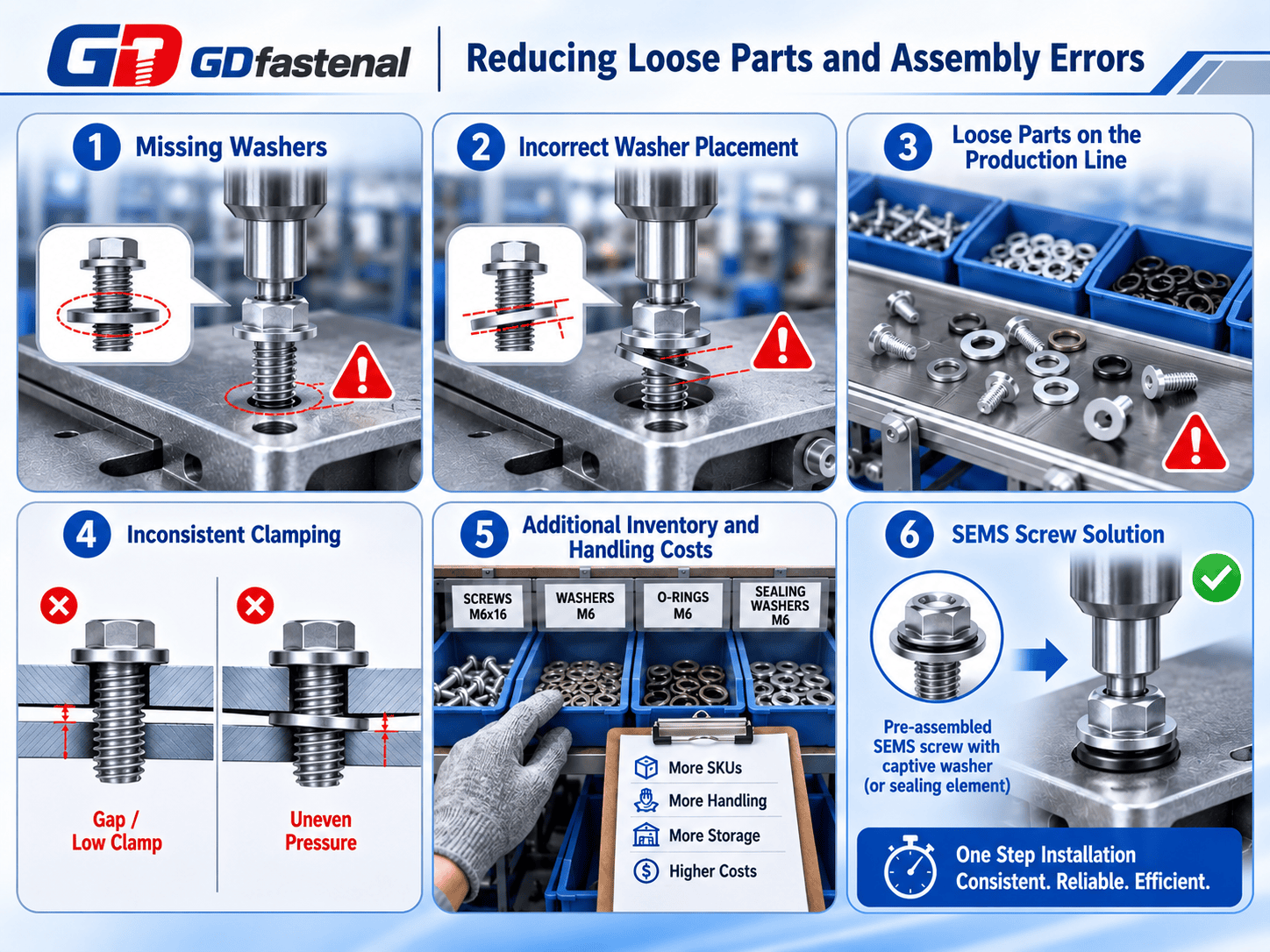
When washers are installed separately, operators or automated systems must handle more components. This increases assembly time and creates several risks:
- Missing washers
- Incorrect washer placement
- Loose parts on the production line
- Inconsistent clamping
- Additional inventory and handling costs
SEMS screws solve this problem by combining a screw with one or more captive washers. Because the washer is pre-assembled, the complete fastener can be installed in one step. When sealing is also required, the same integrated design concept can be applied to sealing fasteners using O-rings, rubber washers or specialized sealing gaskets.
Why choose integrated fastener assemblies?
Compared with separately installed screws, washers and sealing components, integrated fasteners offer several practical advantages.
Faster assembly
A pre-assembled fastener reduces the number of components that workers or automated equipment must handle. This shortens the assembly process and improves production-line efficiency.
Reduced risk of missing parts
Captive washers remain attached to the screw under normal handling and assembly conditions. This helps prevent errors caused by missing washers or incorrectly installed sealing elements.
More consistent load distribution
A flat washer increases the bearing area under the screw head, helping distribute clamping force and reduce damage to the mating surface. Note that vibration resistance may still require additional locking features.
Simplified inventory management
Using one integrated fastener instead of several separate components reduces the number of part numbers that must be purchased, stored and supplied.
More controlled sealing
When a sealing washer or O-ring is integrated, the sealing element is positioned more consistently, reducing dependence on manual application of sealants.
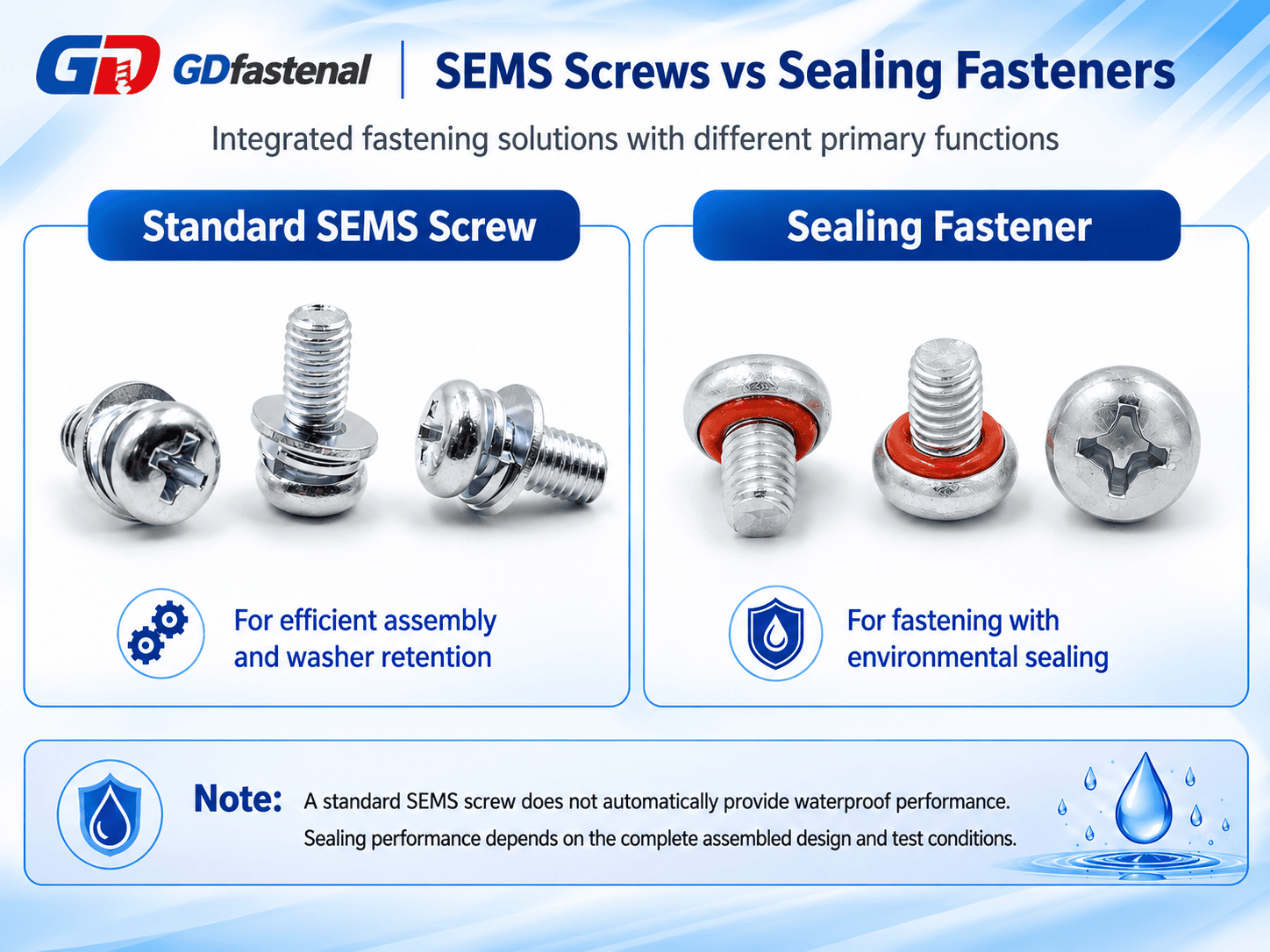
SEMS screws VS. sealing fasteners: same concept, different jobs
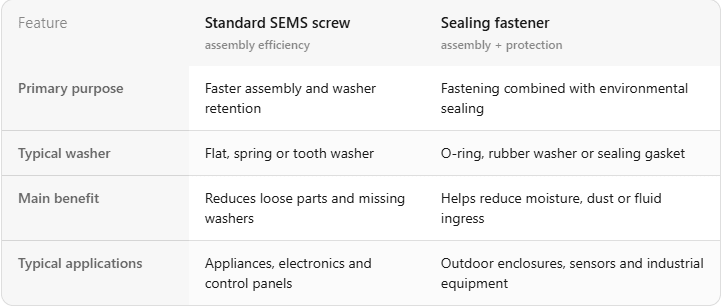
A conventional SEMS screw does not automatically provide waterproof performance. Similarly, a sealing fastener should not be described as IP67 or IP68 by itself unless the complete assembled enclosure has passed the applicable ingress-protection test.
Key engineering factors
The performance of an integrated fastener depends on more than simply attaching a washer or O-ring to a screw.
Washer selection
Different washer types serve different purposes. Flat washers mainly distribute load and protect the contact surface, while spring washers and tooth washers may provide additional resistance to rotation or loosening. The right choice depends on joint material, required clamping force, vibration conditions, electrical requirements and available installation space.
O-ring groove design
For O-ring sealing screws, the groove must provide suitable space and compression. An incorrect groove-to-O-ring volume ratio can cause insufficient sealing, seal extrusion or reduced service life.
Installation torque
Over-tightening does not always improve sealing performance and may damage the O-ring or deform the sealing surface. Suitable torque depends on material, size and joint structure.
Material and surface treatment
Yuhuang supports materials including Stainless Steel 304, Stainless Steel 316, carbon steel and brass, with surface treatments such as zinc plating, nickel plating, passivation and black oxide — so the fastener can be matched to both the mechanical and environmental demands of the application.
When you need both
For projects requiring efficient installation and sealing protection, customized fasteners that combine captive washer structures with suitable sealing elements offer an efficient way to cut part count, simplify inventory and protect the joint at the same time.

