
What 1018, 10B21, 40Cr, and SCM435 Look Like Under the Microscope
Meta Description: Learn how annealing softens fastener steel, eliminates stress, and prepares 1018, 10B21, 40Cr, and SCM435 for cold heading — plus why improper annealing time causes out-of-tolerance hardness.
Keywords: annealing heat treatment, fastener annealing, 1018 annealed, 10B21 steel, 40Cr annealing, SCM435 fasteners, fastener hardness control, cold heading preparation
Every high-quality screw and bolt begins long before the cold header starts — it begins with annealing. As a fundamental heat treatment step, annealing uses a controlled heat → hold → slow-cool cycle to transform the metal's internal structure and optimize its mechanical properties. At GD Fastenal, this process is what allows high-strength bolts to be formed, machined, and finished to exacting standards.
1. What Annealing Actually Does
The annealing cycle moves through three distinct stages:
- Austenitizing (heating) — the steel is heated until its structure transforms into austenite.
- Soaking (holding) — temperature is held to make the structure uniform throughout the material.
- Slow cooling (transformation) — controlled cooling allows the desired microstructure to form.
The result? Five practical benefits: a softer, more workable material; relieved internal stress; refined grain structure; homogenized chemical composition; and a steel that is perfectly prepared for cold heading and machining.
2. Annealed Microstructures: Four Typical Fastener Steels Compared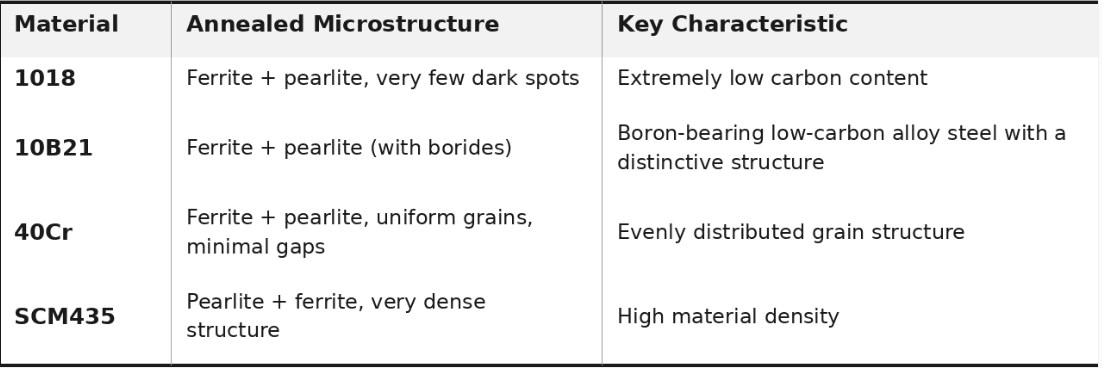
This comparison shows why material selection and heat treatment must be engineered together — the same annealing cycle produces different microstructures, and therefore different forming behavior, in each grade.
3. The Critical Logic Behind the Process Step one: high-temperature treatment
The steel is first heated red-hot at 800–900°C. If it were quenched at this point, it would become extremely hard but brittle — strong on paper, dangerously prone to sudden fracture in service.
Step two: annealing restores toughness
The annealing stage runs at a lower temperature of 500–600°C, and this is where the magic happens: by adjusting the annealing time, different final hardness levels can be achieved — the same logic that differentiates an 8.8 bolt from a 10.9 or a 12.9.
Step three: why hardness goes out of tolerance
In day-to-day production, out-of-tolerance hardness is most often traced back to improper annealing time control — which in turn depends on manual operation discipline and the precision of the conveyor (mesh-belt) furnace equipment. Consistent hardness is not luck; it is process control.
The Takeaway
Annealing is where fastener quality is quietly won or lost. The right cycle softens the steel for forming, builds the toughness that quenching alone would destroy, and sets the hardness foundation for every strength grade on the shelf.
Specifying fasteners for your next project? Browse our custom bolt manufacturing capabilities, or contact GD Fastenal to discuss material selection, heat treatment, and custom fastener engineering.

